Montreal gets the credit, and Torontonians tend to accept it a bit too readily. Toronto had a deli scene of its own — dense, competitive, and in at least one case genuinely bizarre.
Spadina Avenue
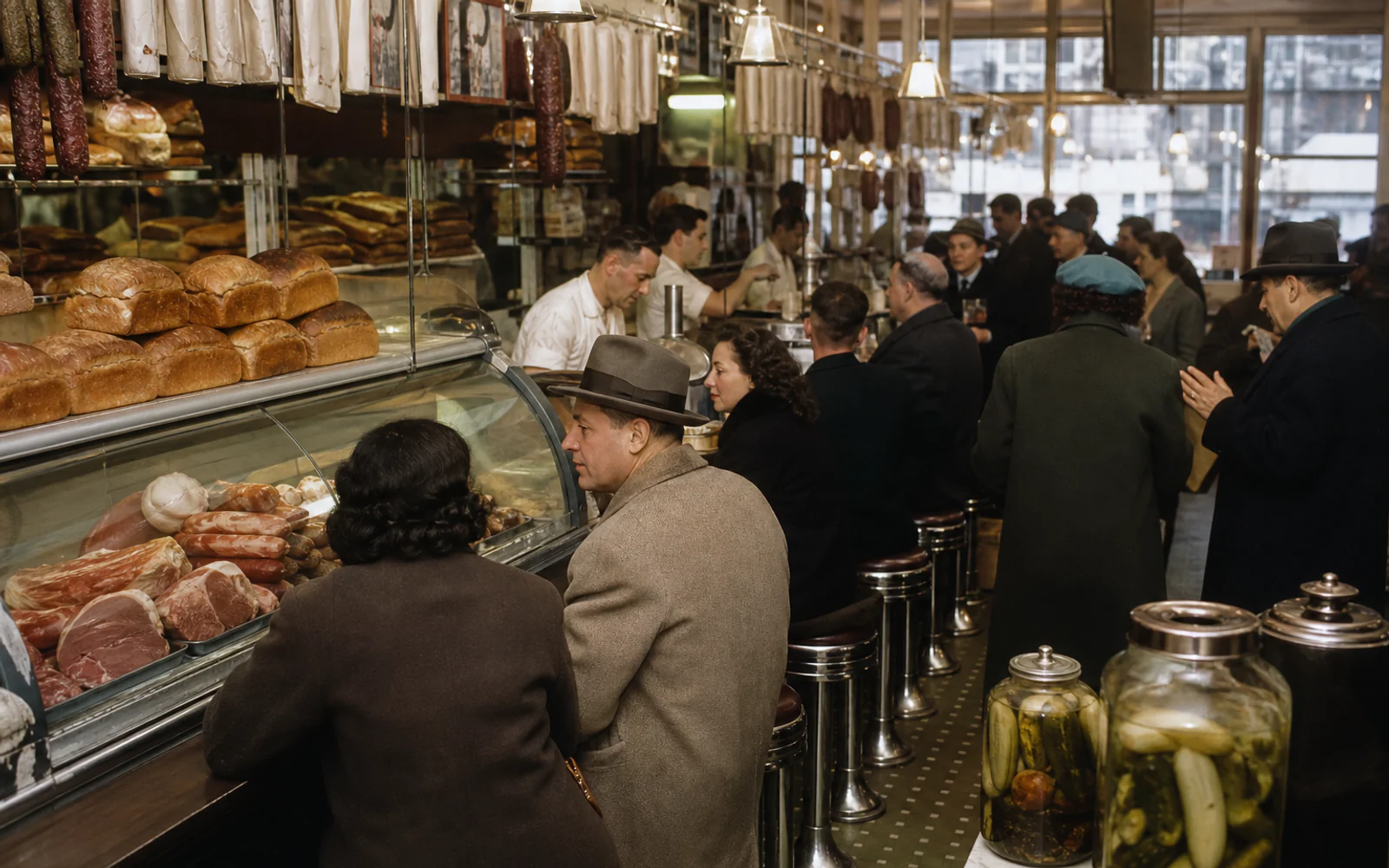
In the early and middle decades of the twentieth century, the centre of Jewish food in Toronto was Spadina Avenue: tailors, immigrant merchants, and the smell of curing meat and fresh bread.
- United Bakers Dairy Restaurant, opened in 1920 by Aaron and Sarah Landovsky, served dairy dishes and soups — no meat at all, which is what kosher rules require if you want to serve dairy.
- Zuchter’s started as a grocery and was turned into a restaurant by Fanny Zuchter in the early 1930s.
- Wexler’s Kosher Restaurant, at 294 Spadina, was founded by a cigar maker, Max Wexler.
Shopsy’s, and the accordion
The giant was Shopsy’s. In 1921 Harry and Jennie Shopsowitz, Polish immigrants, opened an eighteen-seat ice cream parlour at 295 Spadina. By the mid-1940s the business had swung decisively to savoury food, and after Harry died in 1945 his sons Sam and Izzy renamed it and took over.
Sam Shopsowitz was billed in 1947 advertising as the "corned beef king." Harold Ballard — later the owner of the Maple Leafs — pushed him to open a dedicated meat plant to keep up with demand. Shopsy’s ended up producing more than two hundred delicatessen products, most of them carrying Sam’s face in a chef’s hat.
Here is the part nobody expects. Sam was a frustrated musician who played the accordion, and he ran a Shopsy’s booth at the Canadian National Exhibition right beside the grandstand, where he fed the cast and crew of the grandstand shows on trays of deli meat. That generosity bought him friendships across show business. Jimmy Durante called him "Shotsy." He became close to Mitch Leigh, the composer of Man of La Mancha — and helped financially back the original Broadway run.
The sign wars
Across the street from Shopsy’s stood Switzer’s Delicatessen, at 322 Spadina, and the competition was fought in paint. Switzer’s hired Nathan Appleby, a Toronto sign painter whose work echoed the Eastern European trade signs that advertised kosher butchers, and briefed him plainly: make signs big enough and loud enough to pull customers away from the door opposite.
Getting hired at Switzer’s was a local rite of passage. The owners wanted hard labour and actively discouraged turning up to an interview in a suit — this was a meat business, and they wanted you to know it.
Those signs sat in a golden age of Toronto street advertising, alongside the hand-painted Coca-Cola ghost signs still faintly visible on brick along Spadina and Dundas.
The modern chapter
By the 2000s the traditional delis were closing — rents, demographics, changing tastes. In 2007 Zane Caplansky, unable to find a Montreal-style sandwich in Toronto worth eating, started curing and smoking brisket in his own backyard.
Short of money, he made an odd deal with the Monarch Tavern on Clinton Street, a dive bar that allowed patrons to bring in outside food, and rented its unused upstairs kitchen. Serious smoked meat served out of a room above a bar that smelled of stale beer turned into a phenomenon, which became a full deli on College Street in 2009 and then Thunderin’ Thelma, one of the city’s first modern food trucks.
It did not end tidily. A landlord dispute in 2016 brought late-night lockouts and legal bills, and the College Street location closed for good in 2018.
What Toronto is owed
Toronto’s deli story is less a straight line than Montreal’s and more of a scramble: immigrants improvising, competitors painting over each other, one man financing a musical with sandwich money, another curing brisket in a backyard because he could not buy what he wanted. That is a Toronto story, and it deserves to be told as one.