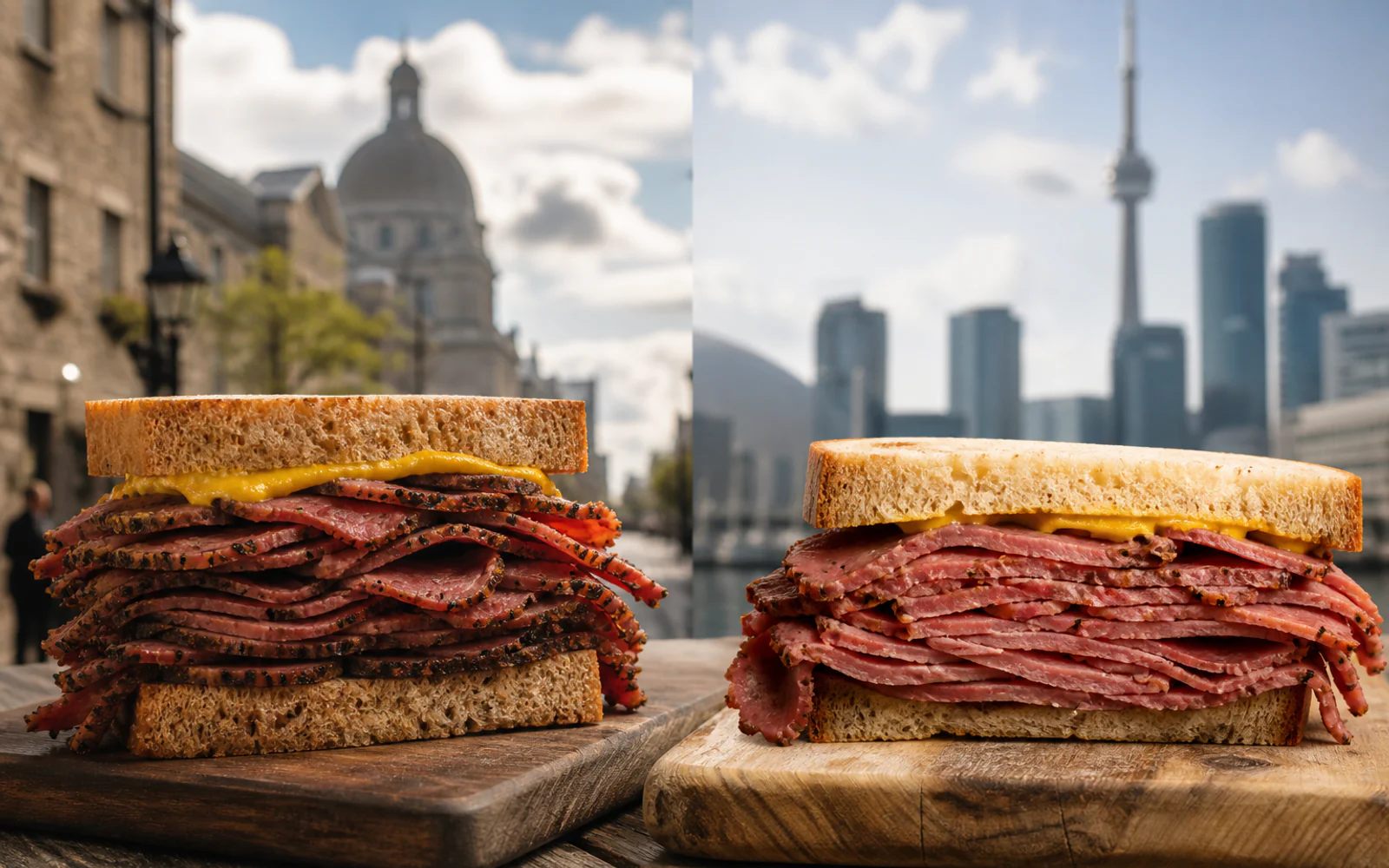
The rivalry is usually framed as a question of quality, which is the least interesting version of it. The real difference is what each city decided to do with the same inheritance.
Same starting point
Both traditions arrive with the same people: Eastern European Jewish families carrying a method for preserving beef with salt, garlic, coarse spice and smoke, because that was how you had meat in winter. Montreal’s first kosher butcher, Aaron Sanft, was advertising smoked meat by 1894. Toronto’s Spadina Avenue delis were well established within a generation.
Montreal narrowed
Montreal turned it into a single, defined dish and then refused to move. Whole brisket, dry-cured in barrels ten to fourteen days, heavy on black pepper and coriander, hot-smoked, steamed for hours, hand-carved, seedless rye, yellow mustard, dill pickle. Order it lean, medium or fatty. That is the whole menu, and deviation is treated as an error rather than a variation.
There is real strength in that. A tradition that narrow is teachable and testable — you can tell instantly when someone has cut a corner. It is also why the dish travelled: there was something specific to carry.
Toronto widened
Toronto went the other way, toward scale and variety. Shopsy’s grew from an eighteen-seat ice cream parlour into a plant turning out more than two hundred products. Delis competed in the street with painted signs. Corned beef was the signature as much as smoked meat, and nobody was trying to standardise anything.
Then it thinned out, and came back differently — a man smoking brisket in his backyard, selling it from a room above a tavern, then a food truck. Less orthodoxy, more improvisation.
Why the meat itself is different
Some of the difference is not culture at all, but butchery. New York pastrami uses the navel; Montreal could not reliably get that cut, because Canadian butchery followed the British tradition, so Montreal used whole brisket instead. Stringier meat, bigger fat cap, and a cut that survives a two-week cure.
The other divergence is the cure. Wet brine is faster, more consistent, and adds water weight — which is why most corned beef and a good deal of commercial pastrami uses it. Dry-curing in barrels takes two weeks and yields less. Montreal kept the slow one.
Where that leaves us
Ryan learned this food in Montreal and now caters it in the Greater Toronto and Niagara area, which is a more natural pairing than the rivalry suggests. The method is Montreal’s: whole brisket, dry cure, real smoke, long steam, carved by hand in front of your guests.
What is local is everything around it. Ontario orchards supply fruitwood — apple, cherry, peach — that gives a cleaner, sweeter smoke than imported hickory and lets a peppery Montreal rub come through instead of burying it. Niagara has a red, Baco Noir, whose acidity cuts brisket fat the way mustard does. Ontario has more good stout and amber ale than any brisket needs.
Montreal technique, Ontario terroir. Nobody has to lose that argument.