Three different delis have claimed to have invented Montreal smoked meat. The archives point somewhere else entirely.
Ask around and you will get three confident answers, all of them wrong in the same way — they name a famous restaurant rather than the person who was doing the work before restaurants were involved.
The three claims
Reuben Schwartz, a Romanian immigrant, opened Schwartz’s Hebrew Delicatessen on Saint-Laurent in 1928 and became synonymous with the food. He guarded a preservative-free spice blend and a dry-cure process with real discipline. He popularised it enormously. He did not invent it.
Benjamin Kravitz, from Lithuania, opened Bens De Luxe in 1910, reportedly selling smoked meat sandwiches out of his wife’s fruit and candy shop using a brisket cure he remembered from Lithuanian farmers. A lovely origin story. Still not first.
Itzak Rudman, a salami maker, has been credited with bringing the technique to a shop on de Bullion Street in 1902 — closer, and still not the earliest documented trail.
Aaron Sanft, Craig Street
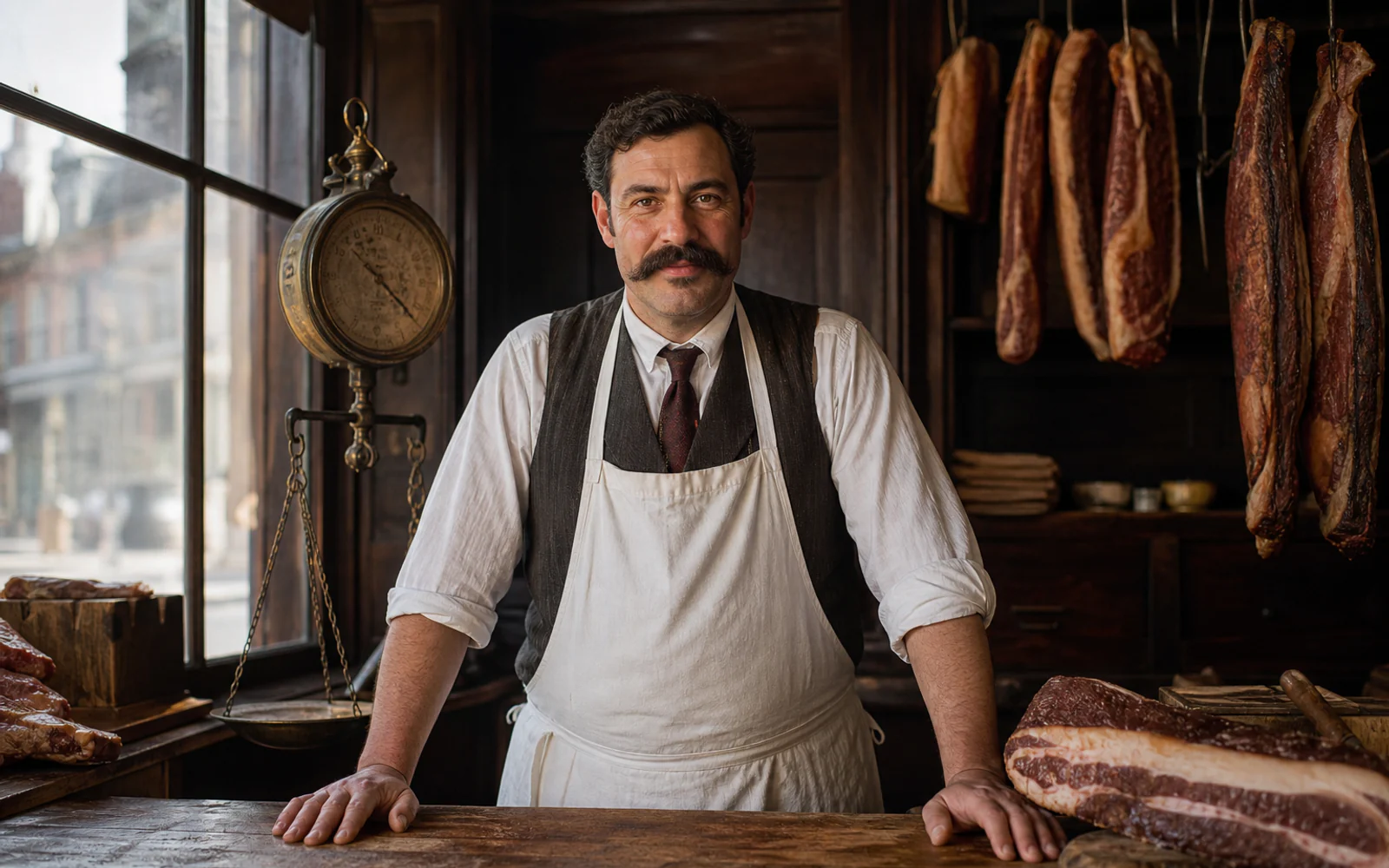
Sanft arrived in Montreal from Iași, Romania in 1884 and became the city’s first kosher butcher, on Craig Street — now Saint Antoine. In 1894 he advertised in a Yiddish-language almanac as a manufacturer of salami, smoked meat, corned beef, smoked beef and sausages.
A butcher, not a restaurateur. Which is exactly why the story got lost: nobody names a sandwich after the person who cured the meat, they name it after the room where they ate it.
Why the correction matters
Because it puts the food back where it belongs. Smoked meat did not begin as a restaurant concept. It began as a preservation technique that Romanian, Lithuanian and Polish Jewish families brought with them because it was how you kept beef edible through a winter without refrigeration. It was survival knowledge that turned out to be delicious.
The delis came later and did something genuinely valuable with it. But the craft arrived in a butcher’s apron, and it is worth remembering whose.