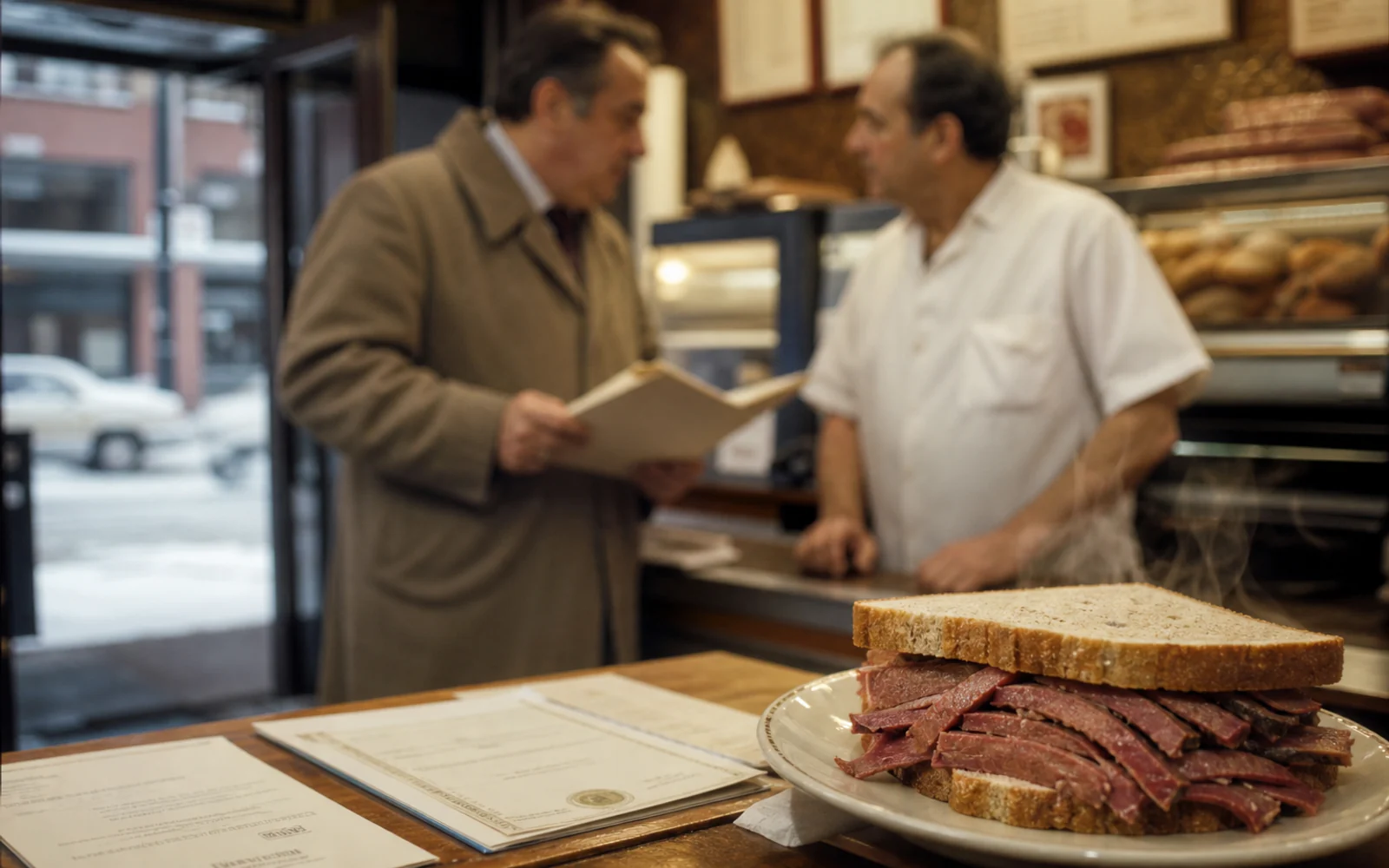
A sandwich went to court over its own name, and won on the grounds that it had become heritage.
After the Charter of the French Language passed in Quebec in 1977, the Office québécois de la langue française began enforcing the predominance of French on commercial signage and menus. Most of that work was unremarkable. One case was not.
Boeuf mariné
Dunn’s Famous Delicatessen, founded by Myer Dunn in 1927, was told that the English words “Smoked Meat” on its signage had to be replaced with the French translation: boeuf mariné. Marinated beef.
Which, as anyone who has cured a brisket will tell you, is not what it is. Marinating is not curing. It is not smoking. It is not two weeks in a barrel followed by three hours in a steamer. The translation was linguistically defensible and gastronomically nonsense.
The argument that won
Dunn’s and other delicatessens fought the directive in court, and their case was not really about language. It was that “smoked meat” is a culinary trademark rather than a generic description — the name of a specific thing made a specific way in a specific city. Rename it and you confuse the customer and sever the dish from its own history.
They won.
An immigrant food had become so thoroughly Quebecois that Quebec could not translate it without damaging it.
Why it is a good story
Because of what the ruling implicitly conceded. Smoked meat arrived with Romanian and Lithuanian Jewish immigrants in the late nineteenth century — outsiders, in a city that was not always warm to them. Less than a century later, the province’s own language authority could not rename their food without a court telling it that the food was now part of the province’s heritage.
That is a fairly remarkable thing for a sandwich to have achieved.