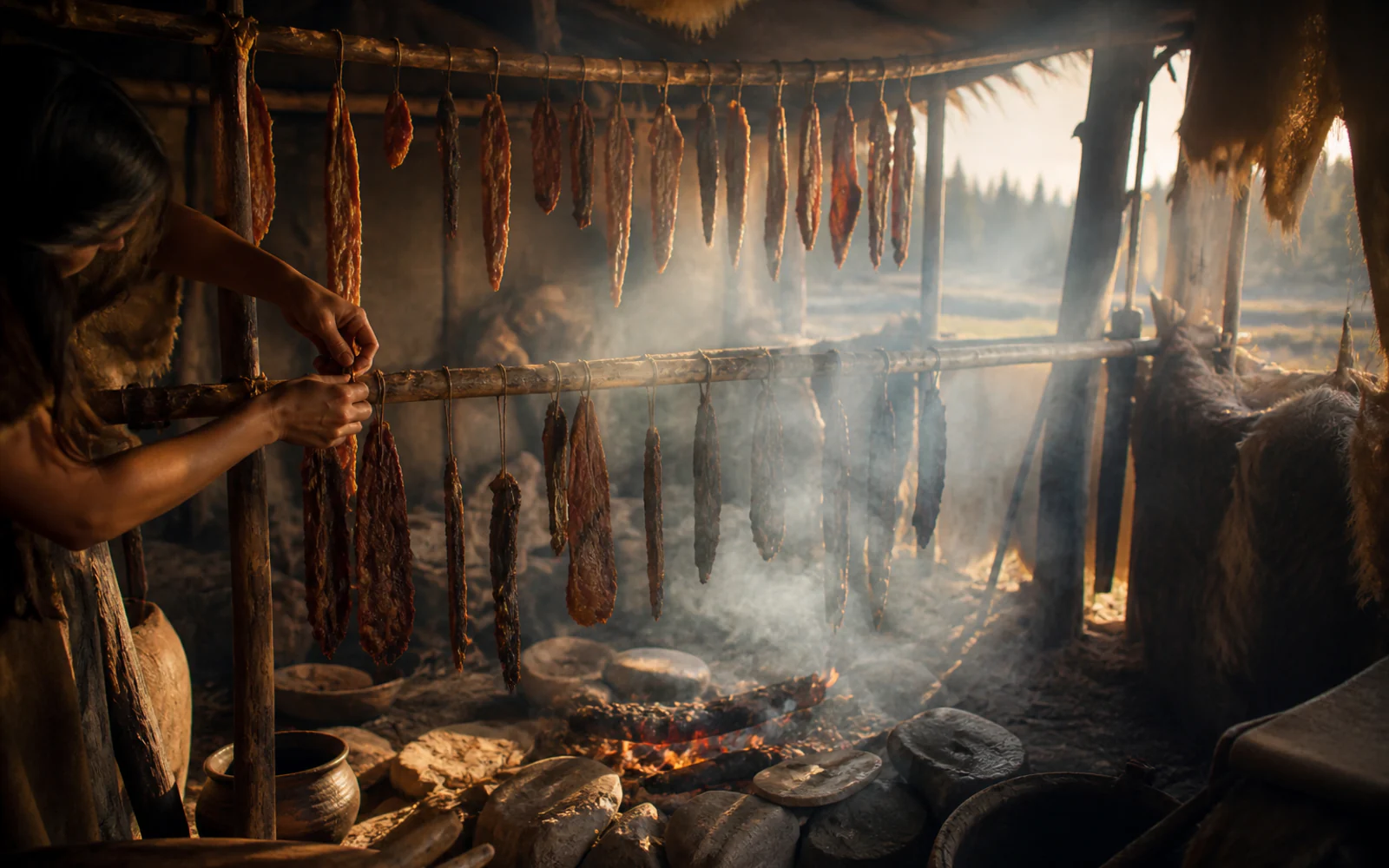
Smoking meat is older than writing, older than agriculture, and very nearly as old as the controlled use of fire. Nobody invented it in one place. Almost every culture that faced a winter, a drought, or a long journey worked it out independently.
That is worth saying out loud, because Montreal smoked meat gets treated as a closed tradition you either grew up in or don’t. The technique underneath it is one of the most widely shared things human beings do with food.
It was probably an accident
The first smoking was almost certainly unintentional. Early people drying meat inside poorly ventilated shelters would have noticed that the cuts hanging in the hearth smoke lasted longer than the rest — and tasted better. Archaeological evidence from Ice Age caves in Europe and charred remains near ancient hearths in Mesopotamia puts the practice tens of thousands of years back.
The same idea, solved differently everywhere
What is striking is how each culture adapted the method to its own climate and its own trees.
- In the Amazon, Indigenous communities built wooden racks over low fires, because in that humidity meat spoils in hours.
- In the Andes, Quechua communities wind-dried and lightly smoked llama and alpaca in the thin mountain air to make charqui — the word, and the food, behind modern jerky.
- In China, smoked meats such as la rou go back at least to the Zhou dynasty, and the choice of wood was already deliberate: pine in the north for its resin, bamboo for a milder smoke, camphor in Hunan and Jiangxi for something sharper.
- Mongol communities salted and dried strips of horse and camel meat for travel across the steppe.
- In the Pacific Islands, Polynesian cooks used earth ovens like the imu to steam and smoke pork and fish underground on hot stones.
- In the Alps, particularly rural Styria, families built free-standing smokehouses — a Selchhaus — with the firebox outside and a flue feeding smoke into a wooden chamber, keeping the temperature low enough for weeks of cold-smoking.
Benedictine monasteries in Europe folded fish and game smoking into their own self-sufficiency, refining methods that eventually crossed the Atlantic.
How it reached a Montreal counter
The particular thread that ends in a Montreal smoked meat sandwich runs through Eastern Europe. In Romania, Hungary and Lithuania, Jewish butchers had long made pastrama — beef or mutton preserved with heavy salt, aggressive garlic and coarse spice, then smoked and dried.
This was not cuisine as leisure. Without refrigeration, that treatment was the difference between having protein in February and not. When those families emigrated at the turn of the twentieth century, fleeing poverty and pogroms, the method came with them in their hands.
What they found in Montreal changed it. Different cut of beef, different wood, different customers. Within two generations a survival technique from the Carpathians had become a thing people queue for on Saint-Laurent Boulevard.
Which is the actual invitation
If your grandparents cured pork, air-dried lamb, smoked fish over alder, buried a pig in an earth oven, or hung anything in the rafters of a kitchen — you are not a stranger to this food. You already know what it is for.
Montreal smoked meat is one local dialect of something close to universal. You do not need a family connection to Saint-Laurent Boulevard to have a claim on it. You need one sandwich, carved properly, and about four minutes.