Montreal technique, Niagara ingredients. The one advantage of doing this here instead of there.
Stop importing hickory
Hickory and mesquite are the default because American barbecue made them the default. Both throw a heavy, assertive smoke that suits a sweet sauce and a long pork cook. Neither is the obvious choice for a peppercorn-heavy Montreal cure.
Meanwhile, Niagara is covered in fruit orchards. Apple, cherry, peach, plum and apricot wood all burn cleaner and sweeter than dense hardwoods, with far less of the bitter creosote risk that comes from a smouldering, resinous fire.
Peach wood is the local secret
Apple is the industry workhorse — reliable, sweet, hard to get wrong. Peach is what competition pitmasters quietly prefer and rarely advertise.
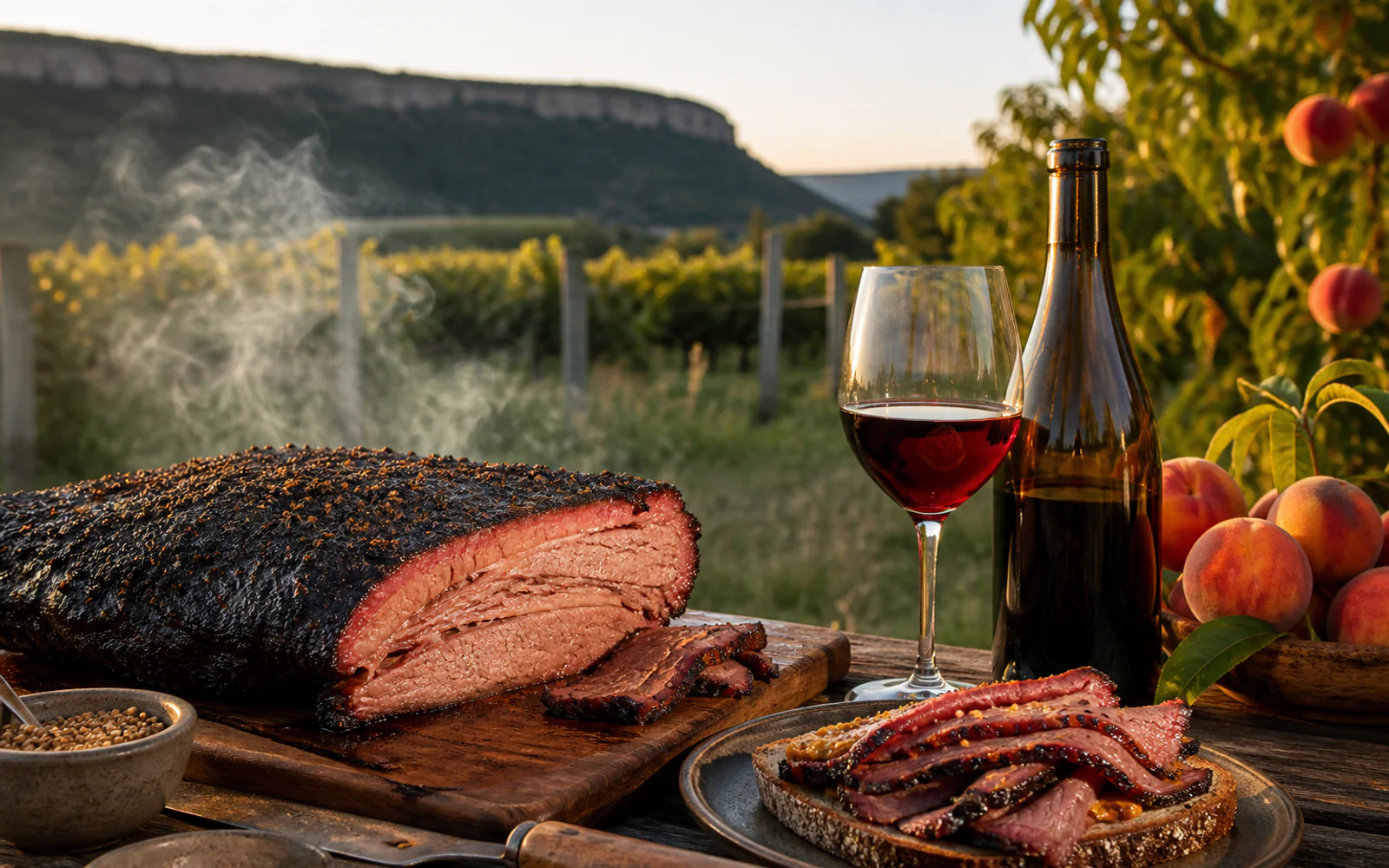
It burns exceptionally clean and produces a delicate, faintly floral, slightly tangy smoke. Because it does not shout, the savoury dry rub stays in front — the coriander and black pepper come through instead of being buried. It also yields a warm amber bark rather than a pitch-black crust, which looks considerably better on a carving board in front of guests.
Cherry, blended with an oak base, does something similar for colour, pulling a deep mahogany into the surface.
And there is a wine built for this
Smoked meat is hard on wine. The fat, salt and smoke flatten a delicate Pinot Noir, and a heavily tannic Cabernet turns metallic against the smoke.
Baco Noir solves it. It is a cold-hardy French-American hybrid that thrives on the Niagara Peninsula, sometimes described affectionately as a blue-collar grape. It produces an inky red with high acidity, dark plum and blackberry fruit, and a distinct inherent smokiness.
The acidity does exactly what the yellow mustard does — cuts straight through the collagen and rendered fat. The leathery, spicy notes meet the peppercorn bark on equal terms rather than fighting it.
If you would rather have a beer
| What you are eating | What to pour | Why |
|---|---|---|
| Fatty point, burnt ends | Porter or oatmeal stout | Roasted malt echoes the bark; the body matches the richness; bitterness cuts the fat |
| Lean flat | Amber ale, West Coast IPA or Märzen | Caramel malt complements smoke; resinous hops lift leaner meat without burying it |
| Anything with a sweet glaze | Brown ale or German lager | Nutty sweetness balances sugar; a clean lager resets the palate |
| Smoked poultry | Hazy IPA or wheat beer | Citrus and tropical hops brighten mild meat; carbonation scrubs the skin fat |
Ontario’s craft scene makes all of it locally. Between the orchards and the breweries, there is a genuine argument that Southern Ontario is a better place to make this food than the city that invented it — which is not a sentence anyone in Montreal will enjoy reading.