People ask what is in smoked meat expecting a long list. It is short. Beef, salt, pepper, coriander, mustard seed, garlic, and time. What makes it taste the way it does is not an ingredient at all — it is four processes, each doing a specific job.
One cut, and not the obvious one
New York pastrami is traditionally made from the navel, a flat, dense, fatty cut from the underside of the animal. Montreal went a different way, and for a practical reason: Canadian butchery followed the British tradition, and the navel cut was hard to come by. So Montreal butchers used the whole brisket instead.
That was a constraint, not a preference, and it changed the food. Brisket is stringier and more fibrous than navel, but it carries a thick, uneven fat cap that insulates the meat through two weeks of curing and hours of smoke. The accident became the signature.
Brisket is also the muscle that supports roughly sixty percent of a steer’s weight, which is why it is laced with collagen and why it cannot be rushed. Cook it hot and fast and the collagen contracts, squeezing the moisture out. Cook it low and slow and the same collagen unwinds and turns to gelatin, which coats the muscle fibres and holds moisture in. Tough cut, tender result, entirely down to patience.
A dry cure, in barrels, for ten to fourteen days
This is the step that separates real Montreal smoked meat from the shortcuts. Corned beef and most pastrami are wet-brined — submerged in salt solution, which is faster, more uniform, and adds water weight to the finished product.
Montreal smoked meat is dry-cured. Whole briskets are hand-rubbed with coarse curing salt and spice, then packed tight into barrels and left to cure in the juices they release themselves. Ten to fourteen days. There is no way to hurry it and no way to fake it.
The spice profile is savoury and unapologetic — crushed black peppercorn, coriander seed, mustard seed, garlic. Where New York pastrami rubs often lean sweet, with sugar or clove, Montreal goes darker and sharper. That is why the bark tastes peppery rather than candied.
Salt, nitrite, and the pink you are looking at
Curing salt does two things. It makes the meat inhospitable to spoilage bacteria — including Clostridium botulinum, which is the genuinely serious one — and it changes the colour permanently.
The chemistry is worth knowing because it explains something people find suspicious. Nitrite converts to nitric oxide in the muscle, which binds to myoglobin, the protein that carries oxygen in muscle tissue. Heat then locks that compound into a stable pink pigment. The pink in cured meat is not dye and not undercooking. It is that reaction, and it cannot happen any other way.
Smoke, which is more than flavour
Smoke is what you get when wood breaks down with very little oxygen. Three components of the wood each contribute something different.
- Lignin yields phenols — guaiacol for the smoky taste, syringol for the smoky smell. Phenols are also antioxidants, which is why smoked fat resists going rancid.
- Cellulose yields aldehydes, which are antimicrobial and raise the acidity of the surface.
- Hemicellulose yields carbonyls and organic acids, which drive the browning reaction that builds the dark bark.
So the bark is not a coating applied to the meat. It is the meat, changed.
And then, crucially, steam
Smoking dries the outside and firms it up. Left there, a smoked brisket is chewy. The last step is two to three hours in a steamer, which finishes breaking down the remaining connective tissue and brings the whole thing to the texture that made the sandwich famous.
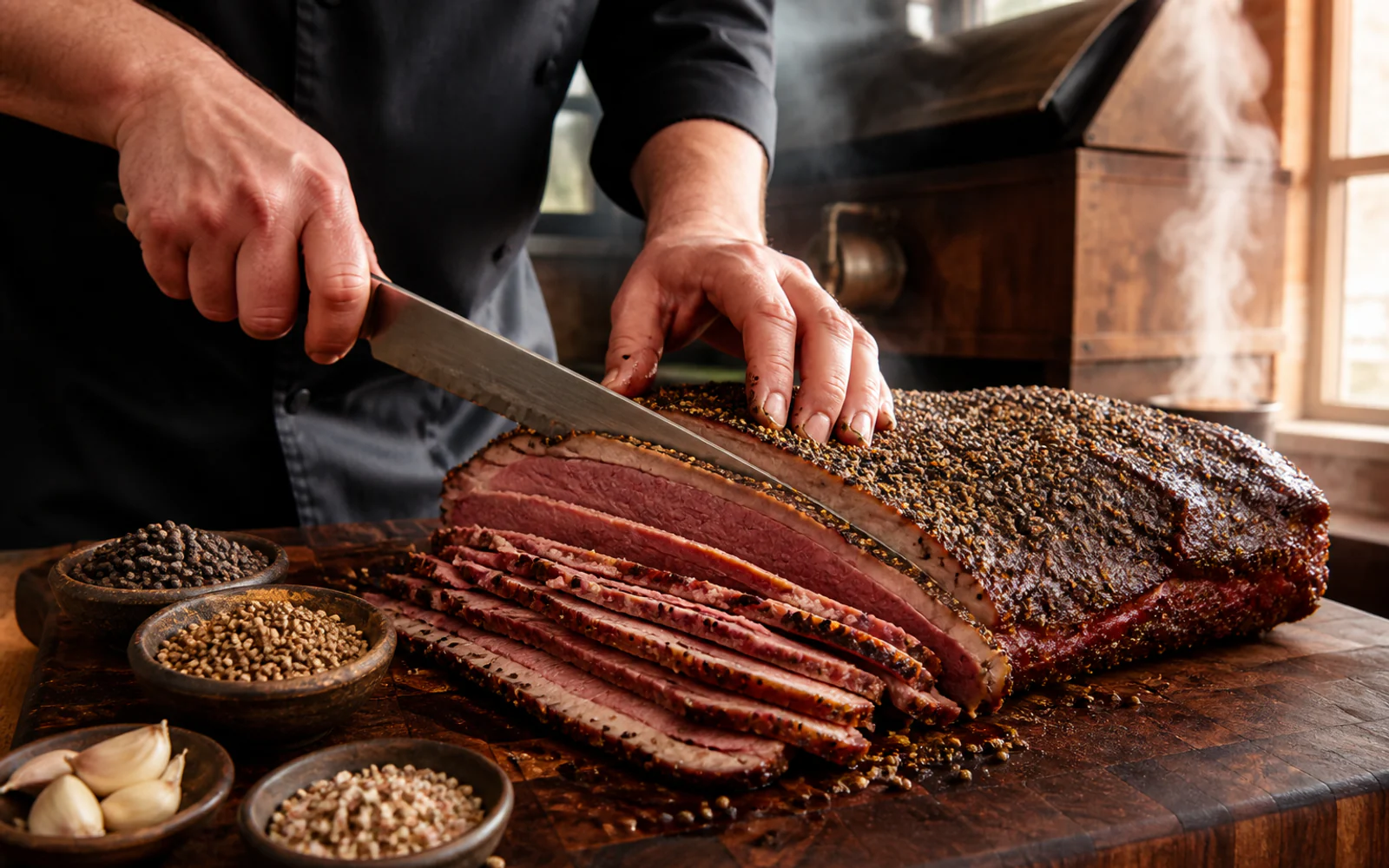
It also explains why it must be hand-carved. Run a hot, steamed brisket through a rotary slicer and the fibres shred into paste. A knife, a steady hand, and a decision about how much fat you want — lean from the flat, fatty from the point, or medium, which is the balance most people are actually after.
So: smoked meat, pastrami, or corned beef?
- Corned beef — brisket, wet-brined, then boiled. No smoke, so no bark.
- Pastrami — navel, wet-brined, smoked, steamed. Sweeter spice.
- Montreal smoked meat — whole brisket, dry-cured in barrels for two weeks, smoked, steamed. Peppery, savoury, and hand-carved.
Same immigrant kitchens, three different answers. We make the third one.