The chemistry is genuinely interesting, and it explains why every step of the process is the length it is.
Smoke is wood taken apart
Smoke comes from pyrolysis — wood breaking down thermally in low oxygen. For good flavour that smouldering wants to sit roughly between 300°C and 400°C. Hotter than that and you destroy the delicate flavour molecules while producing more of the polycyclic aromatic hydrocarbons nobody wants.
Wood has three structural components, and each one gives you something different.
| Component | What it becomes | What that does |
|---|---|---|
| Lignin | Phenols — guaiacol, syringol, eugenol | Guaiacol is the smoky taste; syringol is the smoky aroma. Both are antioxidants that stop fat turning rancid. |
| Cellulose | Aldehydes, mainly formaldehyde | Antimicrobial. Binds to the free amino groups in meat protein, raising surface acidity and making life hostile for spoilage bacteria. |
| Hemicellulose | Carbonyls and organic acids | Acids drop surface pH sharply; carbonyls drive the Maillard reaction that builds the bark. |
The cure is doing something else entirely
Salt and sodium nitrite do two jobs. The first is that nitrite is extremely effective at suppressing Clostridium botulinum — this is not a flavour decision, it is why cured meat does not kill people.
The second is colour. Nitrite converts to nitric oxide in the muscle, binds to myoglobin to form nitrosylmyoglobin, and under heat stabilises into nitrosyl hemochrome. That is the permanent pink of every ham, bacon and smoked brisket you have ever seen.
Worth knowing: meat sold as “uncured”, using cultured celery powder, is still cured. Celery is naturally very high in nitrates, bacteria reduce them to nitrites, and the reaction with myoglobin is chemically identical. The pink colour gives it away.
And then there is collagen
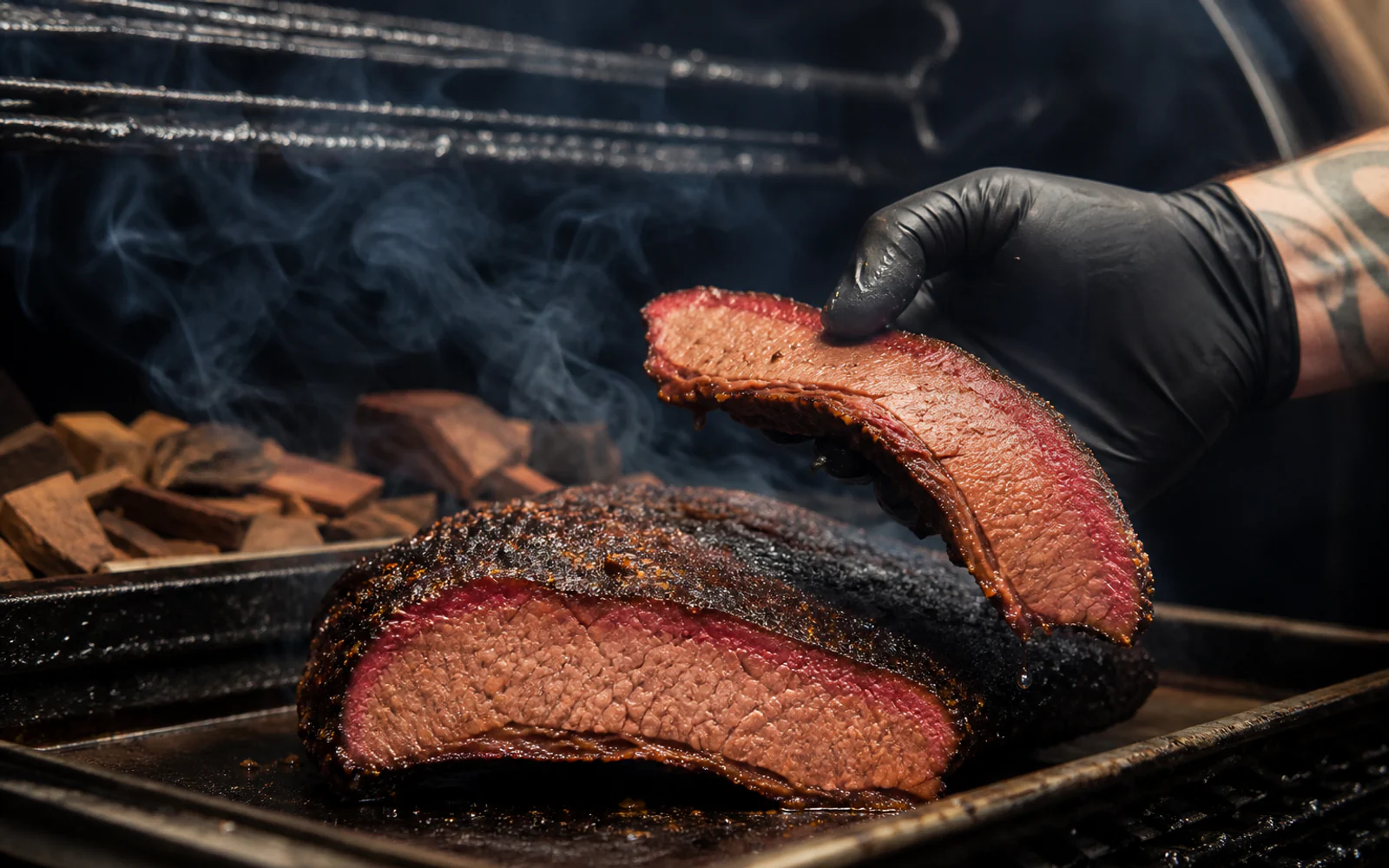
The brisket supports roughly sixty per cent of a steer’s body weight, and it is laced with collagen. Hit it with fast, high heat and that collagen contracts, wringing moisture out of the muscle. You get something dry and unchewable.
Held slowly at moderate temperature — roughly 107°C to 121°C — the same collagen denatures, unwinds and gelatinises. The gelatin coats every muscle fibre and traps moisture. Same cut, opposite result. The entire difference is patience.
Nothing about this food is difficult. All of it is slow. Those are not the same problem, and only one of them can be solved with equipment.